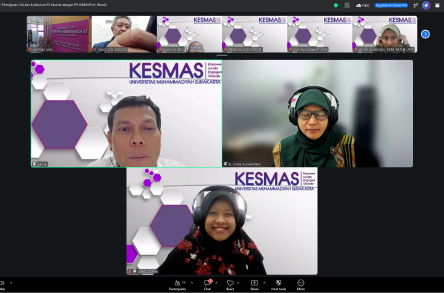
SURAKARTA – The Public Health Study Program, Faculty of Health Sciences (FIK), Universitas Muhammadiyah Surakarta (UMS), continued its review of the Vision, Mission, and Major Curriculum through a discussion with a public health expert, Prof. Dr. Besral, S.K.M., M.Sc., on August 4, 2026. The discussion generated strategic recommendations to strengthen the curriculum and prepare graduates to respond to the evolving needs of the public health profession.
The meeting addressed several key aspects of curriculum development, including Graduate Learning Outcomes (CPL), course structure, the balance between theoretical and practical learning, problem-based learning, specialization practice, primary healthcare, interprofessional collaboration, and curriculum readiness to support future professional education in Public Health.
Prof. Besral noted that, in general, the existing Graduate Learning Outcomes (CPL) of the Public Health Study Program UMS already reflect the competencies expected of public health professionals. However, several areas could be further strengthened, particularly Digital Public Health, Public Health Disaster Management, and Continuous Quality Improvement, to ensure that graduate competencies remain aligned with current public health challenges.
Strengthening Practice-Based Learning and Course Integration
One of the key recommendations was to strengthen practice-based learning. An ideal proportion of approximately 40% theoretical learning and 60% practical learning was suggested. This composition is expected to provide students with greater opportunities to apply their knowledge to real public health problems.
In specialization practice, the integration of related activities was considered feasible by taking into account available resources, user needs, and the interconnected nature of public health problems.
Prof. Besral emphasized that public health problems do not exist in isolation. Therefore, an integrated approach to practical learning can better prepare students to become adaptive and collaborative problem solvers.
In line with this approach, the program was encouraged not simply to increase the number of courses. Instead, courses with overlapping or closely related subject matter could potentially be integrated. If several courses share similar areas of study, they may be combined into a new course while remaining aligned with the needs and direction of the study program.
PBL and Thematic Community Service as Integrated Learning Experiences
The discussion also addressed the implementation of Problem-Based Learning (PBL) and community-based learning activities. PBL 1 and PBL 2, which are conducted in groups, were recommended for implementation in semesters 6 and 7, while PBL 3 could take the form of an internship at an institution selected by the student.
However, implementing PBL in earlier semesters needs to take students’ readiness into consideration, as these activities require students to conduct interventions addressing community problems. PBL may therefore be moved to an earlier semester, but not below semester 5.
Meanwhile, the implementation of a Thematic Community Service Program (KKN) involving students from four different study programs at UMS was considered a positive initiative. This model supports interprofessional and interdisciplinary learning by encouraging students to understand health problems from multiple perspectives and collaborate with students from other fields.
Promoting Interprofessional Collaboration and Primary Healthcare
Prof. Besral also emphasized that public health problems cannot be addressed by a single profession. Interprofessional collaboration is essential to develop more appropriate, effective, and sustainable solutions.
Therefore, strengthening collaboration among study programs and professions is an important component of curriculum development at the Public Health Study Program UMS. Working alongside students from other disciplines is expected to strengthen students’ communication, coordination, leadership, and problem-solving skills before they enter professional practice.
In addition, primary healthcare should be introduced and strengthened from the early stages of students’ education. Students can be exposed to field conditions through observation, interviews with healthcare professionals, identification of priority health problems at primary healthcare facilities, report preparation, and presentation of their findings.
This approach is expected to help students understand primary healthcare not only from a theoretical perspective but also through direct exposure to real-world health issues.
Integrating Faculty Research into Learning
Curriculum development was also encouraged to strengthen the integration of the Three Pillars of Higher Education (Tridharma Perguruan Tinggi), particularly by connecting faculty research with student learning.
Prof. Besral encouraged the program to utilize faculty research on public health conditions and primary healthcare models in partner communities as case studies for classroom learning, rather than limiting research outcomes to academic publications.
Through this approach, students can learn from real-world cases, develop critical thinking skills, and understand how scientific evidence can be applied to analyze and address public health problems.
Preparing the Curriculum for Professional Public Health Education
In relation to the potential development of professional Public Health education, Prof. Besral stated that most components of the existing curriculum already provide a foundation for professional education, although further strengthening is needed in areas such as professional field practice and managerial competencies.
This provides an important direction for the Public Health Study Program UMS to ensure that its curriculum develops not only students’ knowledge but also the practical and managerial competencies required in professional settings.
Regarding the credit structure, Prof. Besral also noted that specialization courses do not necessarily have to reach 20 credits and may be adjusted according to the situation, needs, and vision and mission of the study program.
Strengthening the Learning Assessment System
The discussion also addressed the assessment of Course Learning Outcomes (CPMK) and Graduate Learning Outcomes (CPL). Prof. Besral explained that CPMK assessment is ideally conducted at the end of a course, while CPL assessment should be conducted after students have completed all courses contributing to the respective CPL.
If a CPMK does not meet the minimum standard, lecturers and the study program need to follow up through appropriate evaluation and learning improvement mechanisms. If the same issue repeatedly occurs systematically, intervention at the level of the learning system or its implementation is required to ensure meaningful improvement.
The recommendations from the discussion will serve as important input for the Public Health Study Program UMS in refining its vision, mission, graduate profiles, and curriculum structure. The review process is intended to ensure that the curriculum remains responsive to community needs, developments in public health science, professional requirements, and the future direction of the public health profession.
Through the discussion with Prof. Dr. Besral, the Public Health Study Program UMS further strengthened its commitment to developing a curriculum that is practice-oriented, supported by strong practical learning, integrated across disciplines, based on real-world problems, supportive of interprofessional collaboration, and responsive to digital developments and emerging public health challenges.
The outcomes of this discussion will become part of the development process for the Public Health Study Program Curriculum for the 2027/2028 Academic Year, with the aim of producing graduates who possess not only strong academic competencies but are also adaptive, collaborative, capable of solving complex problems, and responsive to future public health needs.