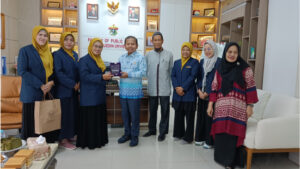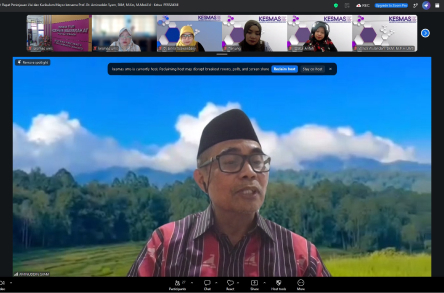
SURAKARTA – The Public Health Study Program, Faculty of Health Sciences (FIK), Universitas Muhammadiyah Surakarta (UMS), continued its review and development of its vision and curriculum through a discussion focusing on the future direction of public health education. The meeting resulted in several strategic recommendations, including strengthening practice-based learning, integrating Islamic values, developing digital competencies, and enhancing students’ learning experiences in community settings.
One of the main focuses of the discussion was the development of a more applicable and integrated curriculum. Public health is considered a complex field because it encompasses not only biology and chemistry but also biomedical sciences, social and behavioral sciences, and various other disciplines. Therefore, stronger connections between courses are needed to enable students to understand public health issues more comprehensively.
To support this approach, the discussion recommended clustering related courses. This strategy is expected to strengthen connections between different areas of knowledge while reducing the academic burden on students when dealing with overlapping or closely related materials.
The discussion also addressed the development of a more structured Problem-Based Learning (PBL) model. PBL is proposed to be implemented through three stages: problem identification, intervention, and evaluation, distributed across different semesters. This approach is expected to provide students with a more systematic learning experience while bringing them closer to real-world public health issues.
In addition, Community Service Programs (KKN) are being considered for integration with PBL activities so that students’ community-based experiences become more structured and directly connected to learning outcomes. The Public Health Study Program UMS is also encouraged to develop Interprofessional Education (IPE) through collaboration among students from different study programs, such as nursing, pharmacy, and nutrition.
In terms of the program’s distinctive characteristics, one of the ideas discussed was the development of a Digital Islamic Public Health course. The proposed course would integrate developments in digital technology within public health with Islamic values and could become one of the distinctive features of the Public Health Study Program UMS curriculum.
Language competency was also identified as an important aspect of curriculum development. In addition to English proficiency to support the program’s global orientation, Arabic language skills are also being considered to strengthen students’ character and expand future opportunities at the international level.
Meanwhile, the existing graduate profiles of the Public Health Study Program UMS were considered fundamentally appropriate. These profiles include roles as managers, researchers, educators, communicators, entrepreneurs, and consultants. However, each profile is expected to be strengthened with Islamic values and character so that they become distinctive characteristics of UMS Public Health graduates.
This character development is also aligned with the understanding that Public Health graduates are not limited to careers within the healthcare sector. With their competencies, graduates may pursue careers in various sectors, including regional development planning agencies, legislative institutions, consulting organizations, international organizations, and institutions such as UNICEF.
Regarding the program’s vision, the Public Health Study Program UMS considers the existing vision to remain relevant for further development, with several areas requiring refinement. These include the placement of the 2029 target year, clarification of the term “public health efforts”, and stronger global orientation and Islamic values.
The meeting resulted in several follow-up actions. The Public Health Study Program team will revise the draft vision, clarify measurable indicators for mission achievement, and strengthen the integration of Islamic values into the vision, mission, curriculum, learning process, and graduate profiles. Further consideration will also be given to the proposed Digital Islamic Public Health course and strengthening English and Arabic language competencies.
Furthermore, the program will examine the implementation of a halaqah approach within PBL activities as a means of strengthening Islamic values. The integration of KKN with PBL, development of IPE, course clustering, and a review of graduate profiles will also become part of the follow-up agenda.
Curriculum development will continue to take into account developments in regulations and professional standards in public health to ensure that the curriculum remains relevant to the needs of the professional world and developments in the discipline. As part of this process, Prof. Dr. Aminuddin Syam may serve as a contact person for the Public Health Study Program UMS to obtain references regarding the implementation of Problem-Based Learning (PBL) and Evidence-Based Learning (EBL) models that have been implemented at the Faculty of Public Health, Universitas Hasanuddin.
Through this series of reviews, the Public Health Study Program UMS is committed to developing a curriculum that is not only academically strong but also practical, globally oriented, adaptive to technological developments, integrated with Islamic values, and capable of preparing students to address increasingly complex public health challenges.