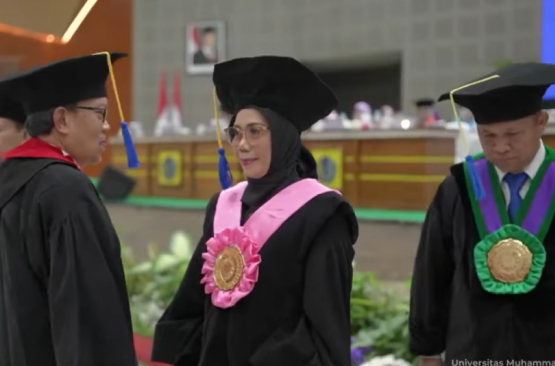
SURAKARTA – The high number of stroke cases has become a serious concern in the health world. A scientific study presented by a Professor of the Faculty of Health Sciences, Muhammadiyah University of Surakarta (UMS), highlighted the importance of comprehensive prevention, rehabilitation, and public education regarding stroke management.
UMS Professor of Neuromuscular Physiotherapy, Prof. Dr. Umi Budi Rahayu, SSTFT., M.Kes., emphasized that stroke remains a significant global health problem. Stroke is known to be the second leading cause of death after ischemic heart disease and a leading cause of disability worldwide.
According to her, most stroke cases are ischemic strokes, which occur due to impaired blood supply to the brain. This condition deprives nerve cells of oxygen and glucose, leading to rapid brain tissue damage.
To improve the recovery of stroke patients, Prof. Umi promotes the application of the concept of neurorestoration, a neurorehabilitation approach that utilizes tissue regeneration mechanisms. This approach can be implemented through structured motor learning to help patients gradually recover motor function.
“Motor learning triggers neuroplasticity, the ability of nerves to adapt and form new connections, thereby improving a patient’s motor function,” he explained.
He also emphasized that motor therapy should be initiated as early as possible, even as early as 1-2 days after a stroke, as long as the patient’s condition allows. Early intervention is believed to strengthen biological changes that support the recovery of nerve function.
As part of innovation in the field of neurological rehabilitation, Prof. Umi and her research team have also developed a Personal Balance Feedback (PBF) device, a device that detects and trains balance in post-stroke patients. This device is designed to be portable and provides real-time feedback on the patient’s balance condition.
For the UMS Public Health Study Program, these findings and innovations serve as an important reminder that stroke treatment should not only focus on curative aspects but also require an integrated promotive, preventive, and rehabilitative approach. Public education regarding risk factors, early detection, and the rehabilitation process is a crucial part of efforts to reduce the impact of stroke on the community.
Through collaborative research and innovation within the Muhammadiyah University of Surakarta, it is hoped that various scientific findings in the health sector can continue to develop and provide real benefits for improving the quality of life of the community.