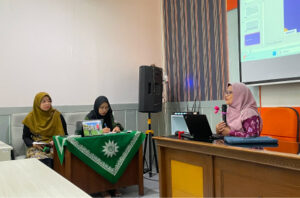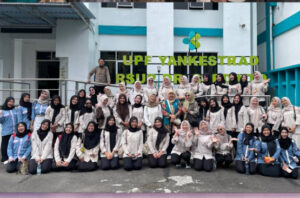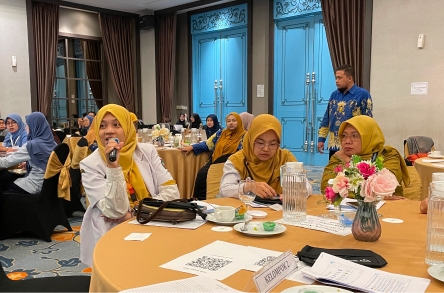
SURAKARTA – The Public Health (Kesmas) Study Program, Faculty of Health Sciences (FIK), Muhammadiyah University of Surakarta (UMS), held a Vision and Curriculum Review Workshop for the UMS Public Health Study Program with stakeholders and the Business, Industry, and Professional World (DUDI) on Monday, July 20, 2026. This activity is part of the UMS Public Health Study Program’s efforts to evaluate and develop its curriculum to address public health needs and keep pace with developments in science and technology.
The workshop involved various stakeholders who have had relationships and collaborations with the UMS Public Health Study Program. Participants came from the Surakarta Regional Government, the Health Office and Community Health Centers (Puskesmas) throughout Greater Solo, health non-governmental organizations (NGOs), the Branch and Regional Leadership of Muhammadiyah Surakarta and Sukoharjo, influencers, entrepreneurs, health experts, and various stakeholders and DUDI (Business and Industry) partners of the UMS Public Health Study Program.
The workshop utilized a Focus Group Discussion (FGD) method as a forum for dialogue and joint evaluation. Through this method, the UMS Public Health Study Program explored various issues, needs, and input from stakeholders and DUDI related to the vision and major curriculum currently implemented. This input is crucial for ensuring the direction of education and graduate competencies remain relevant to the dynamic needs of society, the world of work, and developments in science and technology.
The discussion resulted in several strategic insights. One of these concerns the implementation of Internships and Field Learning Practices (PBL). Several partners hoped that the duration of these activities could be extended so that students have more time to understand the work system, develop skills, and gain more experience while at the partner institutions.
In addition to the duration of internships, stakeholders also highlighted the importance of concrete follow-up to various forms of collaboration between universities and partner institutions. Collaboration is expected not to stop at formal agreements, but to continue through programs with clear plans, indicators, and targets, and to provide mutually beneficial benefits for both educational institutions and partners.
The professionalism of students was also a focus of the discussion. Students participating in internship programs are expected to demonstrate enthusiasm, discipline, responsibility, and a strong work ethic, even while still students. This professional attitude is considered crucial as part of the character-building process and student readiness before entering the workforce.
Meanwhile, Hestu, an influencer from Surakarta and an alumnus of the UMS Public Health Study Program, emphasized the importance of strengthening public speaking skills for public health students and graduates. He believes that effective communication skills are a crucial competency for public health workers to convey health information and education to the wider community.
He also encouraged Public Health graduates to utilize the development of social media as a platform for health education. According to him, health information in the digital space is not solely the domain of specific health professions, but can also be provided by public health workers with competencies in health promotion and communication.
Strengthening the competencies of digital influencers is considered an opportunity for the development of Public Health graduates amidst changing patterns in society’s access to information. Students are not only required to possess academic and technical skills in public health, but also to be able to communicate health knowledge through various media in an engaging, credible, and responsible manner.
Prof. Dr. Heru Subaris Kasjono, S.K.M., M.Kes, a lecturer and professor in Environmental Health and Health Promotion at the Yogyakarta Ministry of Health Polytechnic (Polkesyo), stated that events like this are crucial because they involve various stakeholders who will eventually become the place where these Public Health graduates will work and serve.
Furthermore, Prof. Heru stated that these stakeholders will provide a platform for study programs and lecturers to carry out the Tri Dharma of Higher Education, such as community service and research. He also emphasized the importance of digitalization in higher education, as this will significantly contribute to the development of learning in the next five years. He also suggested incorporating digitalization into several courses that are suitable.
Dr. Kshanti Adhitya, Sp.EM, MM, a doctor at Soeharso Hospital and an emergency medicine specialist with experience in the emergency room, expressed his appreciation for the UMS Public Health Study Program, as this event aligns the program’s vision with the need for increased knowledge. He hopes that UMS Public Health Study Program graduates will be globally competitive and meet national and international standards, while also becoming agents of change in improving the quality of public health for the Indonesian nation.
The various inputs obtained through the FGD will then be used as evaluation and consideration by the UMS Public Health Study Program in compiling and developing the curriculum to be implemented in the 2027/2028 Academic Year. This process is expected to produce a curriculum that is more adaptive to community needs, developments in the workplace, and advances in science and technology.
Through this workshop, the UMS Public Health Study Program affirmed its commitment to developing an education that is not solely focused on academic achievement but also relevant to real-world needs. The involvement of stakeholders and the industrial and industrial sectors is a strategic step to ensure that UMS Public Health Study Program graduates possess competencies that align with the needs of society and the professional world, while also being able to adapt to future public health challenges.