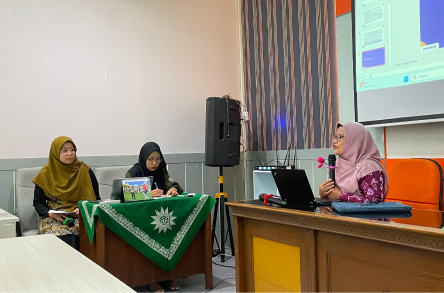
SURAKARTA – The Public Health Study Program, Faculty of Health Sciences (FIK), Universitas Muhammadiyah Surakarta (UMS), continued the development and refinement of its Vision and Major Curriculum through a discussion involving various internal units of UMS on Wednesday, July 22, 2026, at the UMS Library. The activity served as a follow-up to a series of vision and curriculum reviews that had previously involved lecturers, laboratory staff, stakeholders, and representatives from the Business, Industry, and Work Sectors (DUDI).
On this occasion, the Public Health Study Program UMS gathered strategic recommendations from several internal UMS units with relevant expertise in education, learning, research, partnerships, language services, internationalization, and the strengthening of Muhammadiyah values. The units involved included the Institute for Scientific Publication Development and Partnerships (LPPIK UMS), the Directorate of Research, Development, Community Service, and Publications (DRPPPS UMS), the Institute for Course Development and Language Services (LPMB UMS), and the Directorate of Reputation, Partnerships, and International Affairs (DRKUI UMS).
The activity began with a presentation by Nurgiyatna, S.T., M.Sc., Ph.D., a lecturer from the Informatics Engineering Study Program, Faculty of Communication and Informatics (FKI) UMS, who has experience teaching Health Informatics. Nurgiyatna, who also serves as the Director of DRKUI UMS, presented several strategic recommendations that could be considered in developing a globally oriented vision and curriculum for the Public Health Study Program.
He emphasized the importance of strengthening six strategic pillars, including internationalization at home, student mobility, lecturer capacity development, research, and publications, along with other strategic aspects that support the competitiveness and academic reputation of the study program at the international level.
In addition to these strategic pillars, Nurgiyatna highlighted the importance of developing supporting programs to accelerate internationalization. Several programs that could be developed include international classes, double/joint degree programs, international alumni networks, and digital internationalization.
According to him, internationalization should not be understood solely as student mobility abroad. It should also involve creating a global academic experience within the university environment. This can be achieved through stronger international networks, enhanced academic capacity, globally oriented learning, and the use of digital technology to expand academic connectivity.
The discussion continued with recommendations from Dr. Mahasri Shobahiya, M.Ag., Chairperson of LPPIK UMS, who provided input on strengthening the graduate profile of the Public Health Study Program UMS. One of her key recommendations was to consider incorporating the aspect of philanthropy and a philanthropic spirit into the graduate profile.
According to Mahasri, strengthening philanthropic values is highly relevant to UMS’s identity as part of the Muhammadiyah organization, which has a long-standing history of contributing to social movements, education, healthcare, and humanitarian efforts. This value could become an important characteristic of Public Health graduates, enabling them not only to possess professional competencies in public health but also to demonstrate social concern and a strong commitment to creating a broader positive impact on society.
During the discussion, Mahasri also highlighted the importance of preventive efforts against various forms of misconduct and behavior that may conflict with ethical and moral values in society and professional environments. She emphasized that the Public Health Study Program should contribute to equipping students with integrity, ethics, and a sense of responsibility, enabling them to recognize, prevent, and help address potential issues related to such misconduct.
These recommendations are considered essential in developing a graduate profile that is not solely focused on academic and professional competencies, but also emphasizes character, integrity, social responsibility, and humanitarian values. Consequently, graduates of the Public Health Study Program UMS are expected to perform their professional roles responsibly while contributing meaningfully to society.
Meanwhile, recommendations from the Institute for Course Development and Language Services (LPMB UMS) were delivered directly by its Chairperson, Dr. Aryati Prasetyarini, S.Pd., M.Pd. She explained that strengthening English language proficiency is an important component in supporting a globally oriented study program vision and advancing internationalization.
She encouraged students to improve their English language skills through various programs and services provided by LPMB UMS. One of these programs is the English Tutorial Program (ETP), which is designed to improve students’ communication and English-speaking skills.
In addition to ETP, students have opportunities to develop their language competencies through various English-language competitions, including debate, speech, and storytelling. These activities are expected to enhance students’ confidence in communication while preparing them for increasingly global academic and professional environments.
LPMB UMS also provides access to English proficiency assessments, including Regular TOEP and Remedial TOEP, as well as paid online testing services. These services can support students in improving and monitoring their English proficiency throughout their university studies.
Beyond student services, LPMB UMS also provides integrated language services to support internationalization across the university. These services include English training for lecturers and administrative staff, proofreading, translation, and English courses.
The recommendations presented during the forum will serve as important input for the Public Health Study Program UMS in refining its vision, graduate profile, and major curriculum. Feedback from internal UMS units is expected to ensure that the study program’s development remains relevant to public health needs and the world of work, while also aligning with the university’s strategic directions in internationalization, research, publications, human resource development, digital transformation, and the strengthening of Muhammadiyah values.
The activity further demonstrates the Public Health Study Program UMS’s commitment to developing a curriculum that is adaptive, collaborative, character-driven, and future-oriented. The outcomes of this series of vision and curriculum development activities will serve as one of the foundations for preparing the Public Health Study Program Curriculum for the 2027/2028 Academic Year.
Through a development process involving various internal and external stakeholders, the Public Health Study Program UMS is expected to produce graduates who are competent in public health, possess a global outlook, demonstrate strong communication skills, adapt to technological developments, uphold integrity and Muhammadiyah values, have social awareness and a philanthropic spirit, and are capable of contributing to addressing public health challenges at both national and international levels.