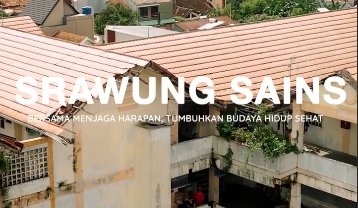
SURAKARTA – The Srawung Sains Program presents science and technology-based innovations to support tuberculosis (TB) prevention in the Panularan Flats 1, Surakarta City. This program was created in response to the high number of TB cases and smoking habits in this densely populated residential area.
The program is led by Dwi Linna Suswardany, S.K.M., M.P.H., a lecturer in the Public Health (Kesmas) Study Program at the Muhammadiyah University of Surakarta (UMS), along with a team of interdisciplinary lecturers from UMS. The activity is also supported by Dian Islami, S.K.M., an Occupational Safety and Health (K3) Laboratory Assistant in the UMS Public Health Study Program.
Through a collaborative approach, the program involves Muhammadiyah University of Surakarta, the UMS Faculty of Health Sciences, the local community health center (Puskesmas), the village government, and the community. This activity also receives funding from the Directorate General of Science and Technology.
Several innovations were implemented in this program, including the construction of separate smoking huts to reduce exposure to secondhand smoke in residential areas, the development of urban farming through hydroponic gardens and family medicinal plants (TOGA), and the use of solar panels as a renewable energy source for public facilities.
The implementation of this program has had a positive impact on the Rusunawa environment. Residents have become more aware of not smoking in residential hallways, while healthier, more beautiful, and comfortable social interaction spaces have also contributed to fostering harmony among residents.
The Srawung Sains program is a concrete example of how collaboration between universities, the government, and the community can create innovative solutions to create healthier residential environments and support TB control in the community.