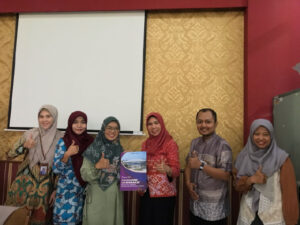
SURAKARTA – The Public Health (Kesmas) Study Program, Faculty of Health Sciences (FIK), Muhammadiyah University of Surakarta (UMS), held a Vision, Mission, and Curriculum Review Workshop on Friday, July 17, 2026, at the Multazam Hotel Solo. This event is part of the UMS Public Health Study Program’s commitment to continuously evaluating and improving its curriculum to ensure it remains relevant to scientific developments, the needs of the workforce, and national policies in higher education.
The workshop was attended by all lecturers and laboratory staff from the UMS Public Health Study Program, who actively participate in the learning process, both in class and in practicum activities. Through this forum, various input and evaluations were gathered to form the basis for formulating the direction of curriculum development and refining the study program’s vision and mission.
The head of the program, Izzatul Arifah, S.K.M., M.P.H., explained that the curriculum review is a periodic evaluation agenda to ensure that graduates’ learning outcomes remain aligned with the evolving needs of society and the professional world.
“This curriculum review is a form of evaluation of the previously implemented curriculum and will serve as the basis for future curriculum development. In addition to seeking input from lecturers, we also involved laboratory assistants because they play a crucial role in assisting students and lecturers in practical activities, providing invaluable perspectives on the learning process,” Izzatul explained.
He added that the curriculum evaluation process does not stop within the study program. In the next stage, the UMS Public Health Study Program will involve various external partners who have collaborated in implementing field learning, such as community health centers (Puskesmas), the Health Office, hospitals, and other partner institutions.
“Input from graduate users and partner institutions is crucial to ensure the curriculum truly meets the needs of the workplace and future developments in public health issues,” he added.
Meanwhile, Tanjung Anitasari I K., S.K.M., M.Kes., Head of Quality Assurance for the UMS Public Health Study Program, explained that this workshop was part of the implementation of the higher education quality assurance system, which refers to the Regulation of the Minister of Higher Education, Science, and Technology (Permenristekdikti) Number 39 of 2025 concerning Quality Assurance in Higher Education.
According to her, reviewing the vision, mission, and curriculum is one form of implementing a quality culture that must be carried out systematically and continuously by each study program.
“Curriculum evaluation is not only to comply with regulations, but also a strategic effort to ensure the quality of graduates is maintained and able to adapt to the dynamics of developments in science, technology, and societal needs,” Tanjung explained.
Through this workshop, the UMS Public Health Study Program hopes to produce a vision, mission, and curriculum that is increasingly adaptive, innovative, and oriented towards stakeholder needs. By involving the academic community and external partners in the evaluation process, the UMS Public Health Study Program continues to strengthen its commitment to producing graduates who are superior, professional, have Islamic character, and are ready to face public health challenges at the national and global levels.