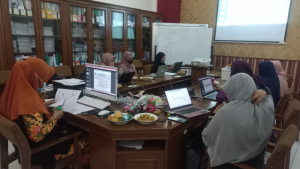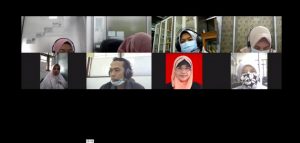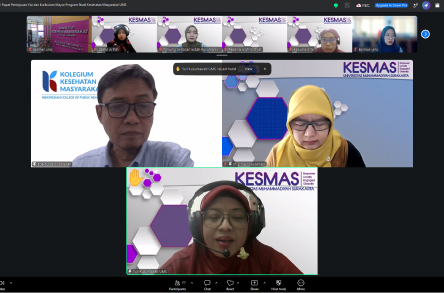
SURAKARTA – The Public Health Study Program, Faculty of Health Sciences (FIK), Universitas Muhammadiyah Surakarta (UMS), continued its series of reviews of the vision, mission, and curriculum through a meeting with Prof. Dr. Ede Suryadarmawan on Tuesday, August 4, 2026, held online via Zoom. The meeting was part of the Public Health Study Program UMS’s efforts to ensure that its educational direction, graduate profiles, and curriculum remain relevant to developments in public health sciences and national policies.
The discussion covered several strategic aspects, including the relevance of the program’s vision and curriculum, graduate profiles, entrepreneurship, Islamic values, and the potential development of professional education in Public Health. Based on the discussion, the vision and curriculum of the Public Health Study Program UMS were generally considered relevant to developments in the field of Public Health, particularly in the context of primary healthcare services, which remain one of the strengths of the discipline.
However, the meeting also provided recommendations to ensure that the formulation of the vision does not excessively limit the scope of the Public Health Study Program to primary healthcare services. Health development has a broader scope, while strengthening primary healthcare is one component within it. Therefore, primary healthcare may be positioned as one of the program’s distinctive areas without limiting the overall scope of its vision.
The discussion also reviewed the existing graduate profiles of the Public Health Study Program UMS, which include Manager, Leader, Researcher, Educator, Communicator, Entrepreneur, and Consultant. These profiles were considered consistent with national standards while also accommodating the MIRACLE concept. The graduate profiles are also considered sufficiently broad to provide graduates with opportunities to pursue careers in various fields.
Entrepreneurship was one of the key areas highlighted in the curriculum development discussion. Entrepreneurship was considered important to retain because Public Health graduates have career opportunities beyond conventional healthcare sectors. Entrepreneurship can also be developed not only within economics and business but according to the competencies and needs of the Public Health field.
The meeting also discussed developments in national policy following the enactment of Health Law No. 17 of 2023, particularly concerning the position and requirements of Public Health professionals. These policy developments have become an important consideration for the Public Health Study Program UMS in preparing its graduates and examining the possibility of developing professional education in Public Health in the future.
In this context, UMS is not currently required to immediately establish a professional Public Health education program. However, the university needs to conduct an internal assessment of its readiness and institutional capacity before making a decision regarding the development of such a program. The Public Health Study Program will also participate in discussions and coordination concerning the development of professional Public Health education at the Central Java level in Semarang.
Beyond academic and regulatory considerations, the discussion also explored UMS’s potential as a foundation for strengthening the Public Health Study Program. The educational environment in Surakarta and the Muhammadiyah ecosystem, with its strong historical, social, and institutional foundations, were identified as comparative advantages that can be further utilized. Islamic values, philanthropy, and altruism were also considered relevant to be continuously integrated into Public Health education.
Based on the meeting, the Public Health Study Program UMS will undertake several follow-up actions, including refining the formulation of its vision, maintaining and strengthening its graduate profiles in accordance with national standards and the MIRACLE concept, and further strengthening entrepreneurship within the curriculum.
In addition, the Public Health Study Program UMS will conduct an internal assessment of UMS’s readiness and capacity to develop professional Public Health education, participate in coordination regarding professional education development at the Central Java level, and utilize the university’s academic environment and Muhammadiyah ecosystem to strengthen the program’s distinctive character and competitive advantages.
Through this series of vision and curriculum reviews, conducted progressively with input from various parties, the Public Health Study Program UMS is committed to developing an educational direction that is broader, adaptive, and responsive to developments in science, regulations, and community needs. The process is expected to produce a curriculum that maintains the program’s strengths in Public Health while further strengthening entrepreneurship, Islamic values, and graduate readiness to respond to the future development of the profession.