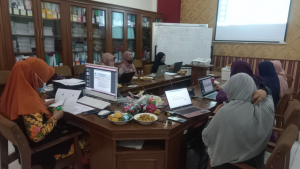
SURAKARTA – The Public Health Study Program, Faculty of Health Sciences (FIK), Universitas Muhammadiyah Surakarta (UMS), held a Semester Learning Plan (Rencana Pembelajaran Semester/RPS) Workshop involving all lecturers from the Public Health Study Program as well as lecturers from other study programs who teach courses within the Public Health Study Program. The workshop was part of the program’s efforts to ensure that its learning plans remain relevant to the latest academic policies and responsive to developments in higher education.
The workshop aimed to ensure that the RPS used in the learning process is aligned with the latest UMS policies, consistent with the curriculum and Graduate Learning Outcomes (CPL), and effective in supporting student learning outcomes. The RPS was also reviewed to ensure that it accommodates developments in science, technology, and the arts (IPTEKS), as well as the needs of stakeholders.
The activity provided an opportunity for lecturers to evaluate the RPS currently used in their respective courses, including the alignment between learning outcomes, learning materials, teaching methods, and assessment systems. Such alignment is essential to ensure that every learning activity has a clear direction and contributes meaningfully to the achievement of the Graduate Learning Outcomes established by the Public Health Study Program UMS.
In her opening remarks, Head of the Public Health Study Program UMS, Izzatul Arifah, S.K.M., M.P.H., emphasized the importance of aligning course assessment with the established Course Learning Outcomes (CPMK) and the latest accreditation requirements.
“The program expects every lecturer to conduct course assessments based on the established CPMK and the latest accreditation requirements. The achievements should also be aligned with the predetermined CPMK, so that when lecturers teach, they already understand what kind of assessment should be given,” said Izzatul.
According to her, clear CPMK and assessment systems from the beginning will help lecturers ensure that the learning process is implemented according to the targeted competencies. This is also important for maintaining consistency between learning planning, implementation, and evaluation.
Izzatul also highlighted the importance of maintaining well-organized and comprehensive academic documentation. Complete and systematic documentation is essential for supporting academic evaluation and providing evidence of learning implementation, particularly in preparation for future accreditation processes.
“We also hope that everything will continue to be documented better and more completely, so that we will not face difficulties during future accreditation activities,” she added.
Through this workshop, the Public Health Study Program UMS encouraged improvements to the RPS that go beyond administrative compliance and are instead based on evidence and the results of learning evaluations. In this way, the RPS can function as a dynamic learning instrument that is continuously improved in response to curriculum developments, academic policies, advances in science and technology, and stakeholder needs.
The involvement of lecturers from other study programs who teach within the Public Health Study Program also plays an important role in maintaining learning alignment across courses. This collaboration is expected to strengthen the connection between course content and the competencies that students need to develop as future public health professionals.
The outcomes of the workshop are expected to serve as a foundation for the improvement and development of the RPS for the Public Health Study Program UMS, enabling the learning process to become more structured, measurable, well-documented, and focused on achieving student competencies.
Through continuous RPS improvement aligned with the curriculum and Graduate Learning Outcomes, while remaining responsive to developments in science and technology and stakeholder needs, the Public Health Study Program UMS continues its commitment to providing a learning process that is relevant, effective, evidence-based, well-documented, and oriented toward continuous quality improvement in higher education.